
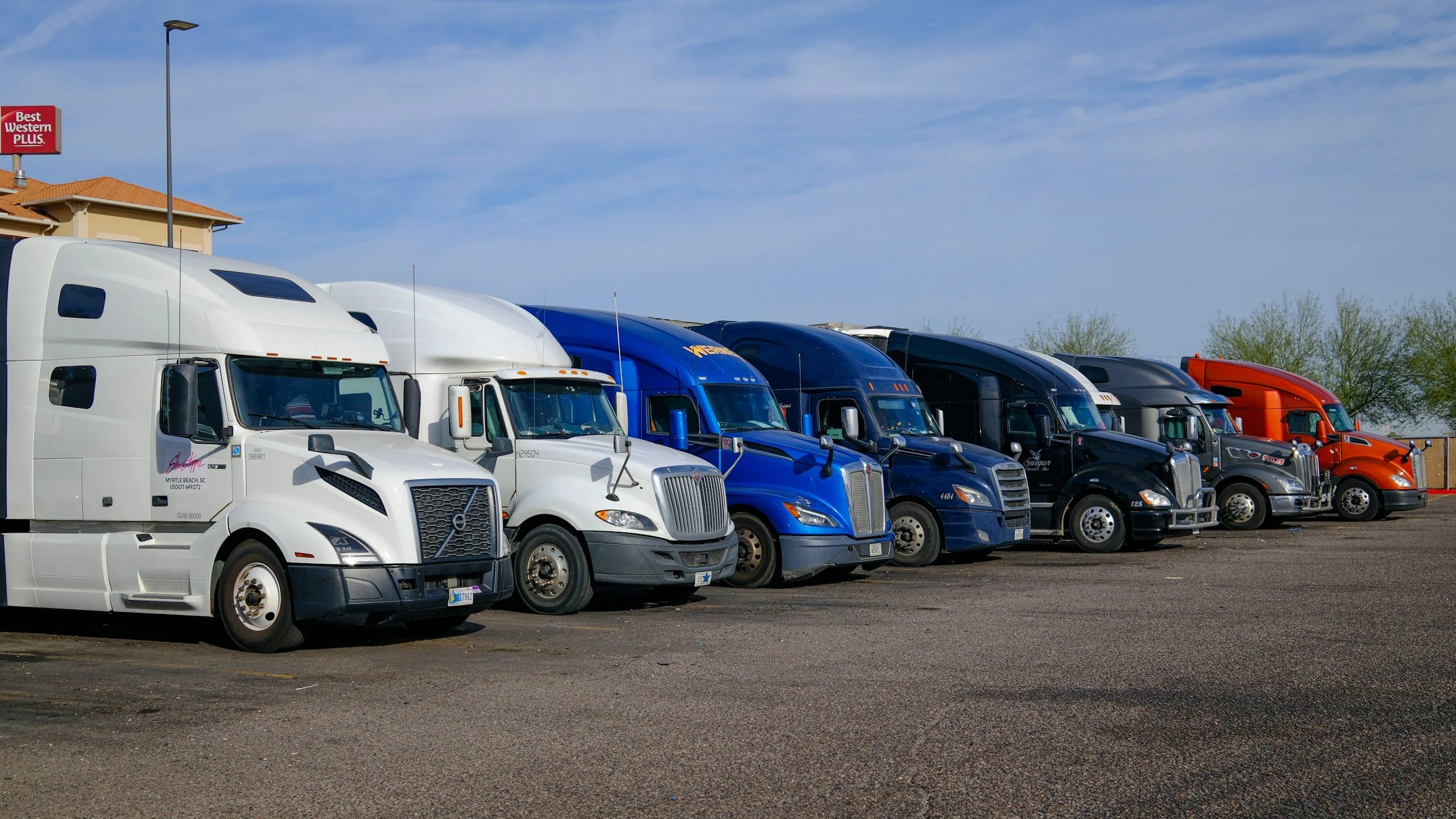
Trucking Company Business Broker in Florida
Sell My Trucking Company in Florida
Strategic carriers, private equity-backed transportation platforms and regional fleets are buying Florida trucking companies. Each one reads your authority, safety record, insurance and truck debt differently. We help you see what you actually net and close without losing drivers or shippers.
Smaller fleets work with our Florida business brokers. Larger dedicated and specialized carriers work with our mergers and acquisitions consultants. Either way, you start with a confidential conversation about what you want next.
Two Ways to Sell a Trucking Company in Florida. We Match the Process to Your Fleet.
Your fleet size, freight mix, safety record and the buyers active in your lanes decide which path fits.
Mergers and Acquisitions Consultant
Dedicated, Specialized and Larger Carriers
For carriers hearing from strategic acquirers and private equity-backed transportation platforms. Work directly with a mergers and acquisitions consultant who runs a competitive process and puts every offer on the same page.
- Show capability, not capacity. Present dedicated contracts, lane density, specialized equipment and niche freight the way platform buyers underwrite them.
- Clear safety and insurance first. Review your FMCSA record and loss runs before a buyer's insurer prices your fleet.
- Compare the whole offer. Weigh cash at closing against debt payoff, working capital, rollover equity and your role after the sale.
- Protect value through closing. Manage authority transfer, equipment payoffs and driver retention alongside your legal and accounting advisors.
Florida Business Brokers
Owner-Operated and Regional Fleets
Our Florida business brokers help fleet owners sell to regional carriers, owner-operators and individual buyers, with the confidentiality a trucking sale demands.
- Price on real earnings. Present seller’s discretionary earnings, freight mix and fleet condition so a buyer and their lender can say yes.
- Reach qualified buyers confidentially. Screen buyers and their financing before anyone learns which carrier is for sale.
- Know your net before you list. Build the fleet schedule and payoff math so the headline price matches what you keep.
- Plan the handover. Script driver and shipper communication and your transition period before closing.
Not sure which path fits your fleet? Start with a conversation →
M&A Advisor and Business Broker Services for Trucking Company Owners at Every Stage
From the first “should I sell my trucking company?” conversation to the wire at closing, and the years of preparation in between.
Sell-Side M&A Advisory for Carriers
Preparation, safety and insurance review, confidential outreach to strategic carriers and transportation platforms, and a competitive process through diligence and closing.
See our M&A advisor services →Exit Planning for Fleet Owners
For owners one to five years out. We identify what a carrier buyer will pay for, what they will discount, and the steps that raise value: dedicated contracts, driver retention, safety scores, fleet age.
Learn more →Net Proceeds and Debt Payoff Analysis
A fleet schedule with every note, lease and payoff, so you know what you keep at each price before a buyer frames the number.
Learn more →Trucking Company Valuation
A defensible view of what your carrier is worth to each buyer type, the drivers behind that number, and what would move it. Delivered as part of an advisory or exit planning engagement.
Learn more →Unsolicited Carrier Offer Review
Received a letter of intent from a competitor or platform? We assess the buyer, the structure, the debt treatment and the market before you respond, so a single offer does not set your price.
Learn more →Florida Business Brokers for Fleets
A licensed, confidential sale process for owner-operated and regional fleets selling to carriers and individual buyers, with the same care we bring to larger transactions.
Meet our Florida business brokers →


PERSONAL. ON PURPOSE.
People you know.
Advice you can
talk through.
Rajiv Khatri
Managing Partner
Sarah Khatri
Managing Partner
We’ve built and sold businesses ourselves. We understand why selling a trucking company reaches far beyond the deal: your drivers, your shippers and the fleet you built one truck at a time.
Sailfish is boutique by intention. We take time to understand your priorities, explain the tradeoffs between a regional carrier, a private equity platform and an individual buyer, and help you make informed decisions through an important transition.
Our faith informs how we serve: with integrity in our advice, stewardship of what you’ve built, and care for the people a transition touches.
The Credentials Behind Every Closing
Sailfish advisors are trained, certified, and licensed by the industry's most respected associations.



A clear path from your first question to the sale of your trucking company.
Discuss your goals. Prepare your fleet. Move forward with guidance. Our process gives a trucking company sale structure, and we tailor the work for exit planning, a partner buyout or an offer already on the table.
Discuss your goals
Spend about 30 minutes with a managing partner discussing your fleet, your timing and what you want your role to be after a sale. We help identify a useful next step.
Agree on the approach
Decide whether a brokerage sale to a regional carrier or individual buyer, or an advisory process with strategic carriers and platforms, fits. Clarify scope, responsibilities and expectations before the engagement begins.
Prepare the company
Pull your FMCSA record and insurance loss runs, build the fleet schedule and payoff math, and rebuild earnings before any buyer sees terms.
Engage suitable buyers
Present the carrier confidentially to screened buyers who want your lanes, equipment type or customers.
Navigate the transaction
Compare offers on the same page, then work through negotiation, insurance review, authority transfer, equipment payoffs and closing alongside your legal and tax advisors.
700+ Florida Business Owners Trust Us
Real stories from owners who sold, scaled, and succeeded with Sailfish.
Transportation knowledge. Real carrier buyer relationships.
Every type of carrier has its own buyers, its own earnings profile and its own reasons a deal falls apart. We work with the carriers where we know all three: who is acquiring right now, what they pay for, and what they walk away from. With 3,500 qualified buyers, strategic carriers and private equity-backed platforms already in our network, your company goes to the people most likely to value it.
Dedicated fleet · Regional truckload · Private fleet outsourcing→ Temperature-Controlled & ReeferProduce and food lanes out of Florida→ Flatbed & Heavy Haul→ Tanker & Hazmat→ Dry Van Truckload→ Less-Than-Truckload & Final Mile→ Drayage & Port Trucking→ Construction Materials & Dump→ Auto Transport→ Owner-Operator Fleets→ Moving & Household Goods→ Freight Brokerage & 3PLSeparate guide for non-asset logistics→
We’re listening. Not sure what your next step is? That is a good place to start.
“I’m thinking
about selling my fleet.”
“I want to step back
in a few years.”
“A carrier just
made me an offer.”



Selling a trucking company in Florida: your questions answered.
You don’t need every answer before starting a conversation.
-
Not by itself. FMCSA has said operators cannot sell MC numbers individually, but they can sell an entire operation or company and ask FMCSA to record the transfer. Buyers acquire the company, including its safety history, insurance record, contracts and equipment, rather than a standalone number.
-
It depends on the fleet. Owner-operated and regional fleets valued under roughly $5 million usually sell to regional carriers and individual buyers through our Florida business brokers. Dedicated and specialized carriers above that size attract strategic carriers and private equity platforms, and need a mergers and acquisitions consultant to run a competitive process. We help you decide in the first conversation.
-
Significantly. Buyers review your public FMCSA record, inspection history and crash data, and their insurers price coverage based on it. A poor record can raise premiums, limit which shippers will use the carrier and reduce the number of buyers willing to bid. Strong, documented safety programs widen the buyer pool.
-
Most trucking sales close on a cash-free, debt-free basis, so equipment notes, leases and credit lines are paid off from the sale proceeds at closing. Build a fleet schedule with payoff amounts before going to market so you know what you would net at different prices.
-
Yes. Dedicated and contract freight with repeat shippers gives buyers predictable revenue, while spot-market revenue swings with the freight cycle. Industry advisers report buyers are acquiring capabilities rather than capacity, so dedicated lanes, specialized equipment and niche freight types tend to attract stronger interest.
-
Buyers sign an NDA and show the ability to close before they learn which carrier is for sale. Early diligence uses summary data, and your drivers and shippers hear about the transition from you, at the time you choose.
-
Deal activity has been below 2024 levels, but advisers quoted by Transport Topics in July 2026 expected more transactions in late 2026 and into 2027. Carriers with stable drivers, clean safety records and contracted freight are best positioned. Timing should depend on your fleet, insurance renewal and personal goals.
-
That is the best time to talk. Exit planning identifies what a carrier buyer will pay for, what they will discount, and the steps that raise value before you go to market: dedicated contracts, driver retention, safety scores and fleet age. You set the pace.

Thinking about selling your trucking company?
For 25+ years, we’ve helped Florida owners protect what they built and get the full value of it. A carrier you built one truck at a time deserves the same care.
Selling Your Trucking Company: Expert Guides & Insights

Stewardship, legacy, and the next chapter.
A trucking company is more than a balance sheet. It is years of early dispatch calls, payroll made on faith, drivers who became family, and a reputation earned one load at a time. We treat the sale as stewardship: honest advice even when it is not what you hoped to hear, a pace set by your goals rather than our calendar, and the willingness to tell you when a buyer or a deal is the wrong fit. We believe this work is a calling, and we try to do it the way we would want it done for our own family.
Selling a Florida Trucking Company: Authority, Safety Scores and the Fleet Under the Price
By Rajiv Khatri, Managing Partner, Sailfish Equity Advisors
You Cannot Sell Your MC Number. You Can Sell the Company Behind It.
"Operators cannot sell MC numbers individually, but they can sell entire operations or companies and ask FMCSA to record the transfer," a Federal Motor Carrier Safety Administration spokesperson told Overdrive in guidance updated March 18, 2026 (Overdrive). If you want to sell your trucking company in Florida, start there. A buyer is not paying for a number on the side of your trucks. They are paying for the safety history, insurance record, customers, drivers and equipment attached to it.
Sailfish Equity Advisors represents Florida carriers from 15-truck regional fleets to dedicated operations with hundreds of tractors. With 700-plus transactions closed over 25 years, our team has seen how trucking deals actually come together. They rarely fall apart over price. They fall apart over safety records, insurance quotes and truck notes that nobody added up until diligence.
This page is for motor carriers that own or lease their own trucks and employ drivers. If your business is freight brokerage, 3PL or warehousing, a buyer will price it on different terms. See our guide to selling a Florida logistics business for that model.
The Market Is Coming Back, Selectively
Trucking M&A had a rough couple of years. PMCF Investment Banking tracked 121 transportation and logistics deals over the twelve months through mid-2026, flat with the prior year and well below the 168 deals reported in 2024, according to Transport Topics (Transport Topics). Advisers quoted in the same report expect activity to pick up through late 2026 and 2027 as freight conditions stabilize. Federal enforcement of non-domiciled CDL and English-language proficiency rules also pushed capacity out of the market, which helped the carriers that remain.
The more important line came from Lincoln International: "buyers are acquiring capabilities rather than capacity." Commodity, spot-market truckload carriers face weaker valuations. Carriers with something specific, such as dedicated contracts, specialized equipment, a defensible lane network or a niche like temperature-controlled or hazmat freight, get attention.
So the question for a Florida carrier is not whether buyers exist. It is whether your company looks like capacity or like a capability.
What a Buyer Pulls Up Before Your P&L
Before a serious buyer looks at your financials, they look you up. Your USDOT number opens a public record: inspection history, out-of-service rates, crash history, safety rating and your scores across FMCSA's Compliance, Safety, Accountability categories.
That public file shapes everything that follows:
Insurability. A buyer's insurance broker will price coverage for your fleet under new ownership. High crash or violation rates can mean a premium that eats a meaningful share of your profit, or a market that will not quote at all.
Customer qualification. Many shippers screen carriers on safety scores. A poor record can cost a buyer the contracts they thought they were acquiring.
Regulatory risk. FMCSA has said it will consider enforcement where people buy or sell "dormant" or "clean" registrations to evade a safety history. Buyers want a clean, continuous record that matches the operation they are buying.
Get ahead of it. Pull your own record, review every alert category and fix what can be fixed before a buyer sees it. Collect five years of insurance loss runs, because a buyer's insurer will ask for them on day one.
Insurance: The Line Item That Can Reprice the Deal
Trucking is the rare business where a buyer's cost of insurance can swing the valuation by itself. Premiums are a large share of a carrier's operating costs, and they reset with a change in ownership.
Expect the buyer's diligence to include an insurance review by their broker, a review of open claims and reserves, and questions about your safety programs, driver hiring standards, telematics and camera systems. Carriers with strong loss history, documented safety programs and in-cab technology get better quotes. Better quotes mean better offers.
If your coverage is up for renewal in the months before a sale, treat that renewal as a dress rehearsal. The questions your insurer asks are the questions a buyer will ask.
Truck Debt and What You Actually Take Home
Here is the math that surprises trucking owners most. Trucking companies are usually sold on a cash-free, debt-free basis. The buyer pays a price for the business, and you use the proceeds to pay off equipment notes, leases and lines of credit at closing.
If you have financed a young fleet with heavy notes, the headline price can shrink fast once the payoff letters arrive. On the other side, an older fleet that is paid off may carry less debt but more deferred replacement, and a buyer will subtract the cost of trucks they need to buy in the next few years.
Before you go to market, build a fleet schedule with each tractor and trailer, year, mileage, condition, lender, payoff amount and planned replacement date. Then calculate what you would net at a few different prices. Owners who do this early make better decisions about timing and about whether to sell equipment separately.
Drivers, Classification and the Seat Count
A truck without a driver earns nothing. Buyers will look closely at your workforce:
Driver tenure and turnover, by terminal and by type of freight.
Company drivers versus owner-operators. Owner-operator models can work well, but buyers review how contractors are classified and paid, because misclassification claims can follow a company after a sale.
Recruiting cost and pipeline. What it costs you to hire a qualified driver, and how long seats sit empty.
Pay and benefits compared with the carriers your drivers would leave for.
A carrier with stable, long-tenured drivers and low turnover is one of the most valuable things a buyer can acquire right now. Show it with data.
Freight Mix: The Customers a Buyer Is Really Buying
Revenue tells a buyer how big you are. Freight mix tells them how durable you are.
Buyers will break your revenue into dedicated or contract freight, regular lanes with repeat shippers, and spot market loads. They will look at customer concentration, rate history and how quickly you can pass fuel and cost increases to shippers. They will also look at whether your customer relationships can be transferred, including any shipper platform or load board accounts that prohibit assignment without consent.
Florida adds a twist. More freight comes into Florida than goes out, so outbound lanes matter. A carrier with steady outbound freight, from produce, building materials, port cargo or manufacturing, has solved a problem many competitors have not. Make that visible.
Pricing a Carrier: SDE or EBITDA
Smaller, owner-operated fleets are usually priced on seller's discretionary earnings: profit plus the owner's salary and personal or one-time expenses, restated as if one owner ran the company full time. Buyers in that range are often individuals or regional carriers, sometimes using SBA financing.
Larger carriers with professional management are priced on adjusted EBITDA, which replaces the owner's pay with what a hired operations leader would cost. Because trucks wear out on a predictable schedule, buyers of capital-intensive carriers also look closely at the cash a fleet consumes to stay current.
We will not quote a multiple until we have read your books. What moves it up: dedicated contracts, low turnover, a strong safety and insurance record, a young well-maintained fleet and management that runs dispatch without you. What moves it down: spot-market dependence, a single dominant shipper, a poor safety record and deferred equipment replacement.
Twelve Months Out: What Moves the Needle for a Carrier
If you are thinking about selling in the next year or two, these moves change how buyers read your company:
Fix the safety alerts you can fix. Review every FMCSA category where you are flagged, tighten maintenance and hours-of-service compliance, and file data challenges where records are wrong.
Lock in dedicated freight. Convert repeat shippers into written dedicated or contract agreements, even short ones. Contracted revenue is what buyers pay for.
Install or document in-cab technology. Telematics, forward-facing cameras and electronic logs help insurance quotes and give buyers data on how your drivers operate.
Cut driver turnover. Track tenure and turnover by terminal, and fix the terminals that churn. Stable seats are a selling point.
Plan equipment purchases around the sale. Buying new trucks right before a sale adds debt that comes out of your proceeds. Deferring too long adds replacement cost that buyers subtract. Decide deliberately.
Separate personal and business expenses. Clean books make earnings easier to verify and support a better price.
Which Path Fits Your Trucking Company
Sailfish works two paths.
Fleets valued under roughly $5 million usually sell to owner-operators, regional carriers and individual buyers. That sale runs through Florida business brokerage: confidential marketing, buyer screening, lender-ready financials and negotiation of equipment and debt payoff. An experienced business broker in Florida who knows carrier buyers keeps the process moving.
Carriers valued at about $5 million and above, especially dedicated and specialized operations, attract strategic carriers and private equity-backed transportation platforms. That sale calls for a structured process run by a mergers and acquisitions consultant: a confidential information memorandum, competitive offers and negotiation of debt, working capital and rollover terms.
How Sailfish Gets a Florida Carrier Ready for Diligence
We start with your public safety record, insurance loss runs and fleet schedule, because those three documents decide which buyers can say yes. Then we rebuild earnings and run the net-proceeds math at several prices so you know what you would actually keep.
Our network spans about 3,500 acquirers, and for trucking we focus on the carriers and platforms that want your lanes, equipment type or customers. Everyone signs an NDA and shows the ability to close before seeing your name. Drivers and shippers hear about the sale on your timeline.
Find Out What Your Fleet Nets You
Know your number after the trucks are paid off and before a buyer calls. Talk confidentially with a Florida business broker on our team about value, buyers and timing.