

Sell My Garage Door Business in Florida
Your garage door company may combine installation, repair, commercial service agreements, builder accounts, and emergency work. Buyers price those revenue streams differently—and they scrutinize product approvals, permits, callbacks, and dispatch systems.
Sailfish Equity Advisors helps Florida garage door business owners understand value, prepare a buyer-ready compliance file, and run a confidential sale to qualified buyers.



You Can Start Before Every Permit and Product-Approval File Is Perfect
A first valuation does not require a perfect compliance file. Start with three years of financials, your service-versus-install mix, builder and commercial account concentration, FL product approvals or Miami-Dade NOAs, permit samples, callback and warranty records, and the systems that run dispatch when you are away. We will help identify the records that protect price before buyers begin diligence.
What Makes a Florida Garage Door Business Attractive to Buyers?
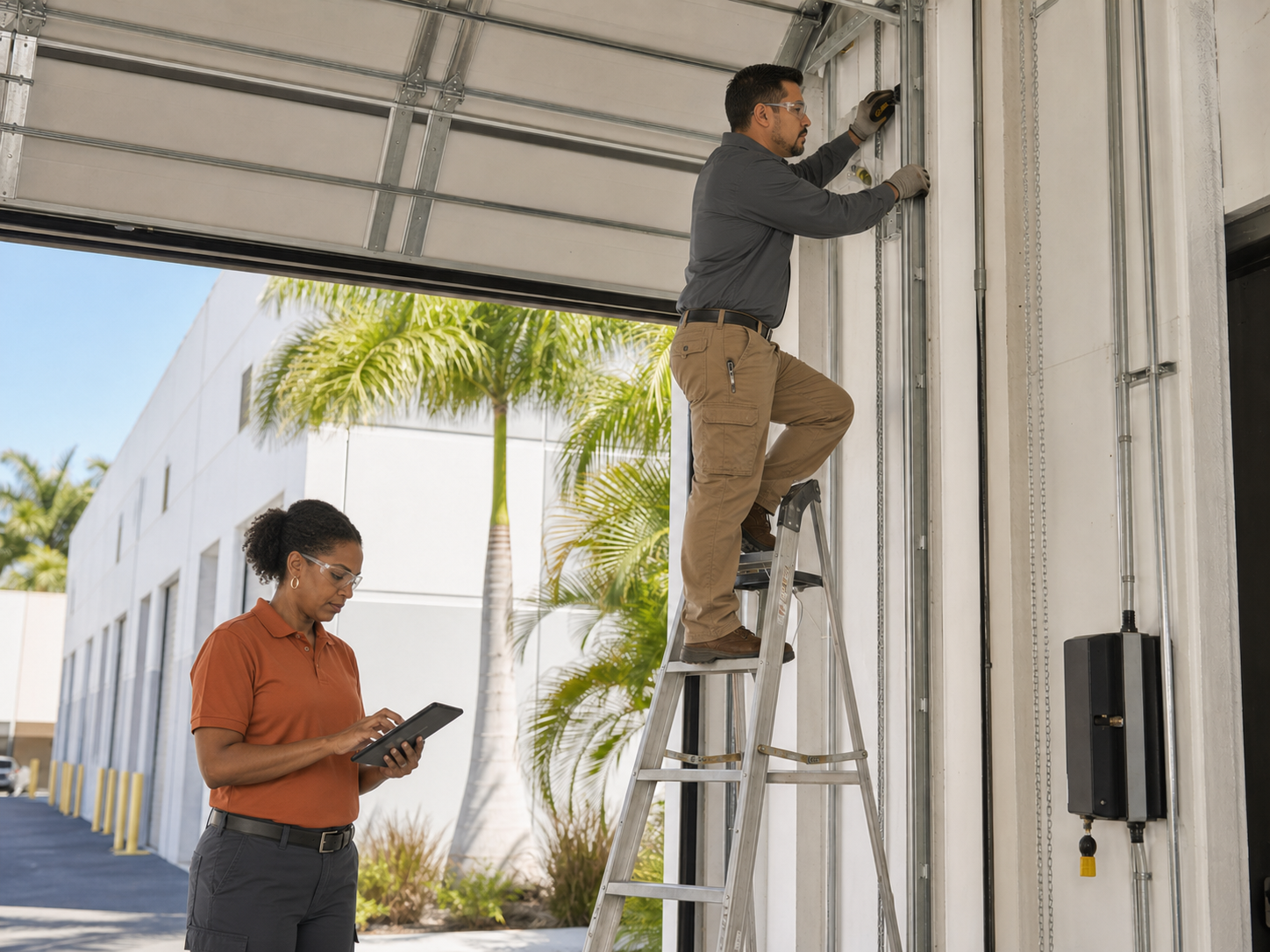
Recurring Service and Commercial PM Base
Repair, maintenance, and commercial service agreements create repeatable demand and reduce exposure to builder cycles.

Clean Product-Approval and Permit Trail
Active FL approvals or Miami-Dade NOAs, closed permits, and installation records help buyers quantify compliance risk instead of discounting it.

Dispatch Systems and Technician Depth
A service manager, field software, written scheduling logic, and trained technicians show that operations can continue without the owner.
Understand What Your Florida Garage Door Business May Be Worth
-

Know What Drives Your Garage Door Business Value
We review service-versus-install mix, commercial agreements, builder concentration, permit and product-approval records, callbacks, technician depth, dispatch systems, and owner dependence to determine what qualified buyers may support.
-

Prepare Before Garage Door Buyer Due Diligence
We organize three years of financials, a defensible add-back schedule, representative job files with permits and approvals, warranty and callback records, customer concentration, dispatch documentation, and key-employee information before buyers ask.
-

Success-Based Support Through Closing
Our compensation is success-based. We manage confidential buyer screening, negotiations, diligence, financing, qualifier and licensing questions, contract assignments, and closing so your garage door sale keeps moving.
Why Choose Sailfish as Your Garage Door Business Broker?

Selling a Florida garage door company requires more than applying a multiple. Buyers separate recurring service revenue from installation work and scrutinize product approvals, permits, callbacks, dispatch systems, technician depth, and builder concentration. Sailfish brings more than 25 years of transaction experience and insight from more than 1,000 business transactions to every engagement.
We help owners prepare the compliance file, restate earnings, protect confidentiality, screen buyers for the ability to close, and stay involved through negotiations, due diligence, financing, and closing—all on a success-based model.
Trusted Through High-Stakes Business Sales
Garage Door Business Sale and Valuation Insights




Meet the Team Advising Florida Garage Door Business Owners
-

Rajiv Khatri
Managing Partner
-

Sarah Khatri
Managing Partner
-

Franklin Luke
Business Sales Advisor
Sell My Garage Door Business in Florida: The Mistakes That Cost You Price
Sarah Khatri, Managing Partner at Sailfish Equity Advisors. Florida Broker License BK3531707.
What actually costs a Florida garage door owner money at closing? Rarely the multiple. Usually a wind-load product-approval file the buyer cannot verify. Every install since December 31, 2023 falls under the Florida Building Code's 8th Edition, and buyers price that documentation gap straight into the offer.
For a garage door owner, Sailfish Equity Advisors does three narrow things: establish what a financeable buyer can genuinely pay, close the documentation gaps that create discounts before anyone else finds them, and run the sale so your installers and builder accounts never hear a word. We are a Florida brokerage that runs sell-side processes for trade and service companies.
Your Compliance File Is Worth More Than Your Trucks
In this trade, the filing cabinet can outvalue the fleet.
Florida regulates garage doors as part of the building envelope. Under Florida Statute § 553.842, exterior doors require state approval before they can be sold or installed. That approval carries an FL number, and the statute then bars local jurisdictions from demanding further testing, provided the product is used consistent with the conditions of its approval.
Those last nine words are where deals get repriced. An approved product installed outside its conditions — wrong opening size, wrong anchor pattern, wrong exposure category — is not an approved installation.
Treating Wind-Load Product Approval as the Manufacturer's Paperwork
The costliest assumption in this trade is that product approval belongs to the manufacturer. The manufacturer earns the approval. The installer inherits the obligation to install inside it and prove it later.
Every door carries a design pressure rating set by wind speed, exposure category and geometry — same model, one neighborhood passes and two miles inland fails. In wind-borne debris regions the door also serves as opening protection, adding an impact rating.
Miami-Dade and Broward sit inside the HVHZ, and there every garage door must carry a large-missile impact rating whether or not it has glass in it. Products get there through Miami-Dade Product Control, which issues a Notice of Acceptance carrying issue and expiration dates. Behind it sit TAS 201, 202 and 203: a nine-pound, eight-foot 2×4 fired at the assembly at roughly 34 mph, then static pressure to the rated load, then thousands of alternating pressure cycles under water spray.
NOAs expire, and code editions move underneath them. The 8th Edition took effect December 31, 2023 per the Florida Building Commission's schedule; the 9th Edition takes effect December 31, 2026. If your standard door package still references an NOA that lapsed two years ago, you have been installing on stale paper — and a diligence team finds that in an afternoon.
How a Buyer Audits Your Product-Approval Trail — and Prices What's Missing
This is the section owners skip, and the one that decides the number. A serious buyer does not read the file cover to cover — they sample it. The sequence we see run on Florida garage door deals:
1. Pull a stratified sample of closed jobs — twenty to forty tickets across three years, weighted toward HVHZ counties and your largest builder accounts.
2. Match each ticket to a permit. Was one pulled, and closed out? Open permits on jobs you invoiced two years ago are a finding.
3. Match the permit to the approval used. The FL number or NOA has to exist, has to have been active on the install date, and has to cover the exact model, size and configuration installed.
4. Check the install against the approval's conditions — anchor type and spacing, jamb detail, track configuration, wind-load labeling. This is where “approved product, unapproved installation” surfaces.
5. Cross-reference callbacks. A callback on a non-conforming install is the cheapest evidence a plaintiff's lawyer will ever get.
Then they price it. Gaps rarely end the deal — the buyer cuts price by an estimated remediation cost, carves out an indemnity with escrow held for years rather than months, or pushes consideration into an earnout so you carry the tail. Across Florida deals we have worked, escrow is the most common and the most damaging: it turns cash at closing into money you may see in 2033.
Selling on the Install Number When the Service Book Sets the Multiple
Owners describe their business by revenue. Buyers describe it by mix.
Nationally, garage door services ran about $16.0 billion in 2026 — roughly $9.6 billion service and maintenance (60%) against $6.4 billion new install and replacement (40%) — per a March 2026 sector brief from FMI Corporation, which counts 15,000-plus independent operators, over 90% under $10 million in revenue.
Those halves are worth different money. Install revenue is builder-driven, cyclical and re-bid every cycle; service revenue arrives on its own, because springs break on a schedule that ignores the housing market and commercial maintenance agreements renew.
Published broker estimates put the ladder roughly here: install-heavy books under 25% repair near 3.5x–4.5x; 40–60% repair near 5.5x–6.5x; repair-led above 60% with a real commercial mix at 6.5x–8x or better. Single-truck shops sell on SDE and land nearer 1.5x–3.5x. For grounding, BizBuySell's sold-transaction data for service businesses over 2021–2025 shows a median earnings multiple of 2.38x.
Keeping Dispatch and Scheduling in Your Own Head
Here is the test. Take a Tuesday off, no phone. If the board still fills and the commercial PM schedule still fires, you own a company. If Tuesday requires you, a buyer is buying a route sheet with your name on it.
Dispatch is the specific dependency here — not sales, not estimating. The owner who knows which tech handles a torsion conversion, which HOA calls at 4:45 on a Friday, and which superintendent takes a next-morning slot holds the operating system in his head, where no balance sheet reaches it. The fix is unglamorous: field software with real job history, written dispatch logic a new hire can follow, a named service manager who owns the board. Buyers pay for systems and discount improvisation.
Carrying Seven Years of Callback Exposure You Never Priced
Owners treat warranty as a line item. Buyers treat it as a tail.
Florida's statute of repose for construction defect claims was shortened from ten years to seven by SB 360, signed April 13, 2023, running from the earliest of a temporary CO, a CO, a certificate of completion, or abandonment. Practically: doors you hung on new construction as far back as seven years remain inside the window.
The claim rarely arrives as a lawsuit. It arrives as a Chapter 558 notice: 30 days to inspect, 10 days to serve copies on subcontractors believed responsible under § 558.004(3), 45 days to respond, and suit permitted once the 60-day period runs.
So diligence asks for your callback rate by job type and installer, any open 558 notices, whether completed-operations coverage extends past closing, and whether builder-contract indemnity follows the entity. Answer with documents and you get paid on time. Answer with reassurance and you get an escrow.
Opening the Books Before You Know the Buyer's Truck Count
Interest arrives fast in this sector. Capacity to close does not.
Screening a garage door buyer starts with two questions that have nothing to do with a bank statement: how many trucks do you run, and how big is your service-agreement base? An operator with fourteen trucks and a commercial PM book knows what a dispatch board is worth and can absorb yours. A first-timer with a spreadsheet and an SBA pre-qualification is underwriting a job, and the structure reflects it. Both deserve a conversation. Neither gets the same information at the same time.
So a blind profile with no company name, city or customer names goes first. An executed NDA plus evidence of capacity comes before financials. The installer roster, builder list and compliance file come last. Run it that way for a plain commercial reason. Your best tech hearing you're selling costs more than any broker fee.
Going to Market With Add-Backs That Won't Survive a Restatement
Seller's discretionary earnings is not the number on your tax return. It is the number that survives diligence once earnings are restated: reported profit, plus your compensation, plus the costs that genuinely leave when you leave, minus anything you cannot document.
That last clause does the damage. The payment on a truck a working tech drives daily is not an add-back — the buyer replaces that expense on day one. A one-time legal bill from a 2024 dispute is, if the invoice exists. Owners routinely present a strong SDE, watch a quality-of-earnings review strip 15% out, then negotiate from a number they no longer believe.
Build the restatement first: three years of financials tied to filed returns, and an add-back schedule a credit committee can read without calling you. Valuation is what qualified buyers can support given your cash flow and their financing, and every dollar of SDE you cannot document is a dollar no lender will underwrite.
What Florida Buyers Are Actually Paying For in 2026
Consolidation reached this trade late and is moving fast. The clearest local case: Banko Overhead Doors, a West-Central Florida operator founded in 1984 and acquired by Blue Ridge Construction Capital on August 5, 2024, announced its acquisition of North Charleston's Southeastern Garage Doors on July 24, 2026 — its first move outside Florida. Nationally, Oak Hill Capital announced its partnership with Guild Garage Group on April 1, 2026; Guild runs 28 local brands across 30 states, terms undisclosed.
Neither is chasing revenue. They want density, service books and clean operations they can bolt on without inheriting a problem. Financing supports the operator-buyer too: the SBA's cumulative 7(a)/504 limit doubled to $10 million effective July 4, 2026, with 7(a) acquisition pricing near 9%–11.5% variable.
The Stages of a Florida Garage Door Sale
Preparation, six to twelve weeks: the SDE restatement, three years of financials tied to returns, the product-approval and permit audit, dispatch documentation, a concentration review. If one builder is over 20–30% of revenue, that conversation happens now.
Confidential marketing, four to six weeks: blind profile, targeted outreach to buyers who operate in this trade, NDAs, screening.
Negotiation to signed letter of intent, usually three to six weeks.
Diligence and closing, the longest block at 60 to 100 days, longer with SBA financing.
Call it eight to eleven months prepared. Unprepared, add however long the fixes take — and fixes cost more under a buyer's deadline than your own.
How Sailfish Prices Your Compliance File Before a Buyer Does
We work diligence in reverse. Before a Florida garage door business goes near a buyer's inbox, we run the audit a buyer would run — permit sample, approval trail, callback log, concentration math, add-back schedule — and price the findings ourselves. Anything that would have become an escrow becomes a fix, or a quantified item you frame first.
From there: a valuation grounded in what buyers in this trade can finance today, a confidential go-to-market that keeps your name off the street, screening that separates operators who can close from browsers who cannot, and positioning that puts your service book in front of the people who pay for it. For how we run sell-side processes statewide, see our Florida business broker overview.
Want to know what your garage door business is worth to a buyer who can actually close? Book a confidential conversation — no cost, and nothing leaves the room.
FAQ: Sell My Garage Door Business in Florida
How much is my garage door business worth in Florida?
It turns on revenue mix far more than revenue size. Published broker estimates put install-heavy books near 3.5x–4.5x, books at 40–60% repair near 5.5x–6.5x, and repair-led books with commercial contracts at 6.5x–8x or higher. Single-truck shops usually sell on SDE, nearer 1.5x–3.5x.
Does a buyer really need product-approval records for my past installs?
Yes, and they sample rather than read everything. A review typically pulls twenty to forty closed jobs across three years, matches each to a permit and to the FL approval or Miami-Dade NOA used, then checks the install against that approval's conditions. With the 9th Edition arriving December 31, 2026, confirm your packages carry unexpired approvals.
How long will it take to sell my garage door business in Florida?
For a prepared seller, roughly eight to eleven months: six to twelve weeks of preparation, four to six weeks of confidential marketing, three to six weeks to a signed letter of intent, then 60 to 100 days of diligence and closing. SBA financing lengthens that last block.
Will my Florida contractor license transfer to the buyer?
No. Florida contractor licenses are held by a qualifying individual rather than the company, so a buyer needs their own qualifier or a written transition arrangement with yours. Florida also issues a state-level garage door installation specialty certification through the Construction Industry Licensing Board — settle this before the letter of intent. - Construction Business Brokers
How does Sailfish Equity Advisors help Florida garage door business owners?
We run the buyer's diligence before the buyer does — permit and product-approval sampling, callback and warranty review, add-back restatement, concentration analysis — then price and fix what surfaces. From there we handle valuation, confidential marketing, buyer screening and negotiation through closing. Sarah Khatri holds Florida broker license BK3531707.